
For PMOs and large companies
Since October 2026 has the tools a project management office needs, in the same software teams use for their tasks. On top of that comes what enterprise IT asks for: sign-in with the company account, an API and webhooks.
What the PMO gets
Everything sits behind one switch in the settings (“PMO features”). Small teams leave it off and see none of it.
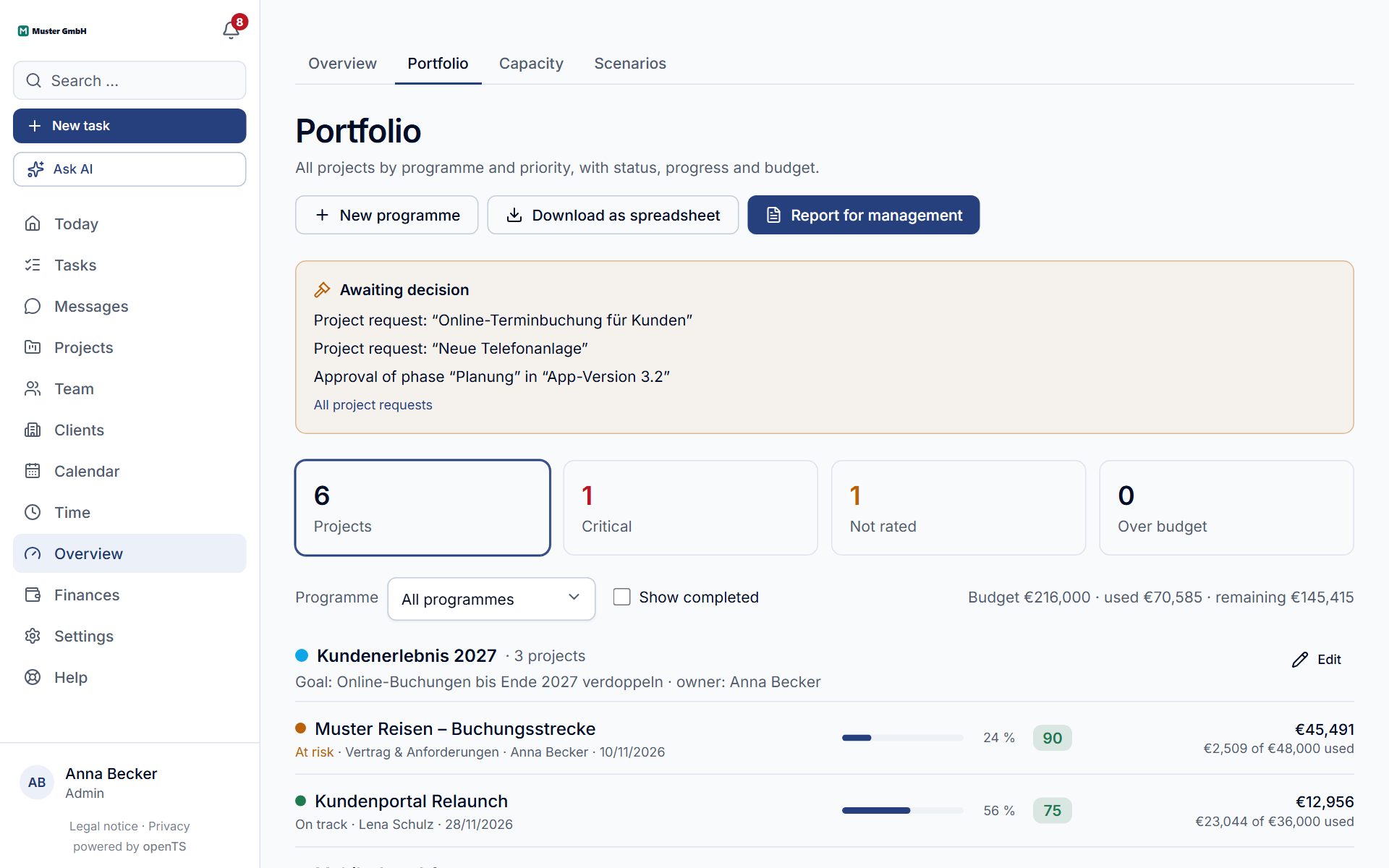
- Portfolio. Programmes, scoring by benefit, strategy and risk with a priority from 0 to 100, budgets of all projects added up and a report for management as PDF.
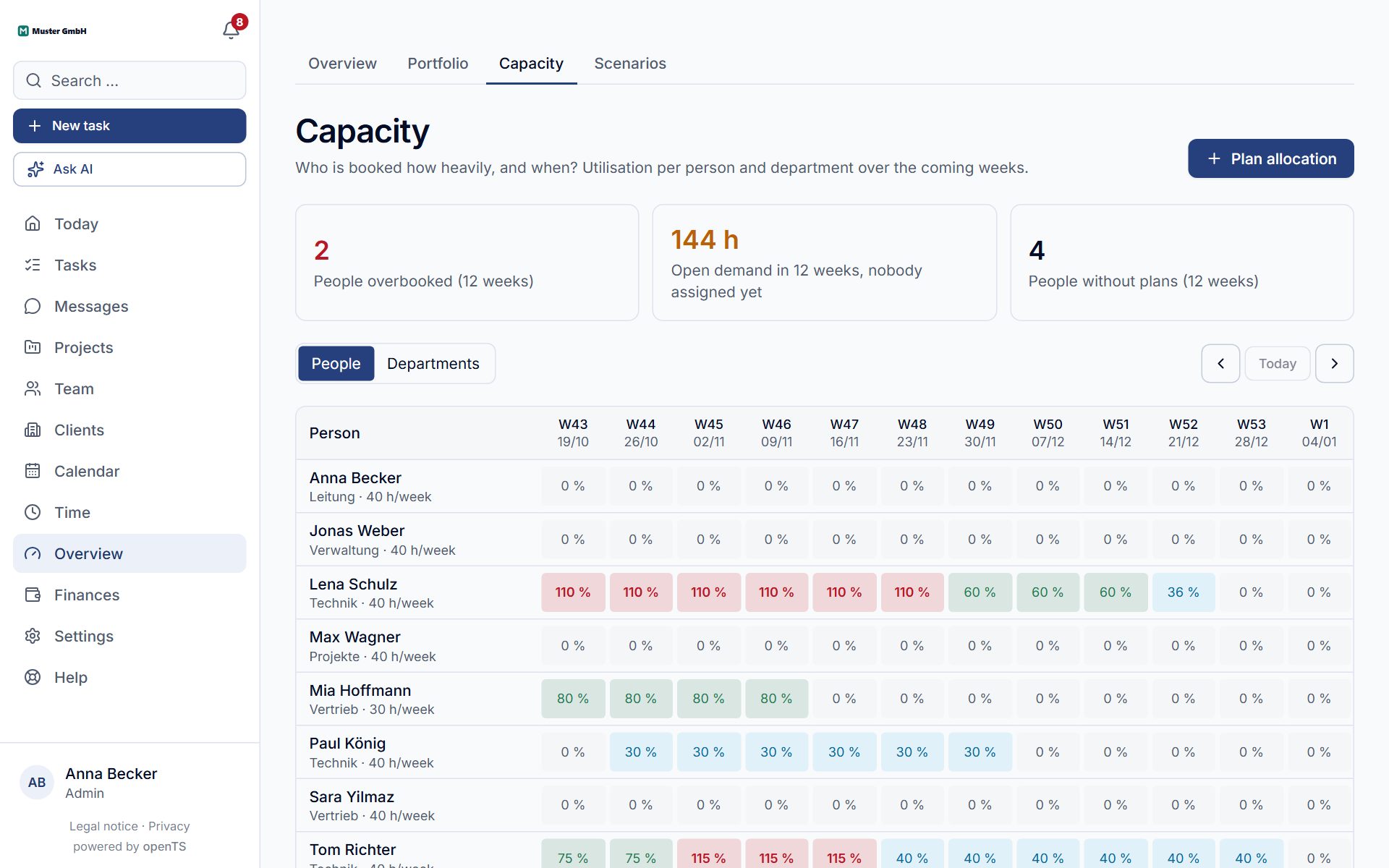
- Capacity. Weekly hours per person, demand per project and role, utilisation per person and department over the coming weeks. Anyone overbooked shows up in red.
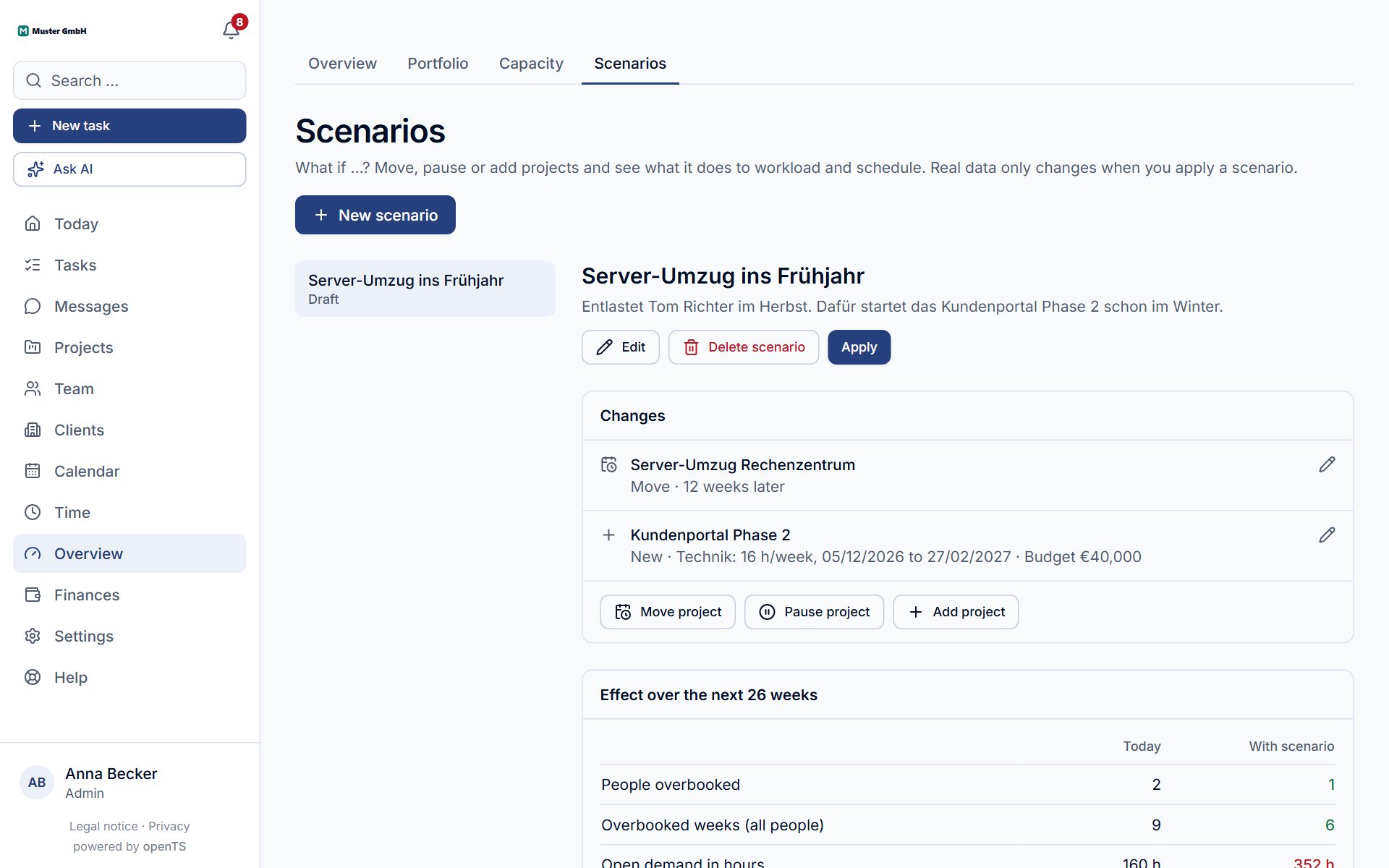
- Scenarios. Move, pause or add projects without touching real data. Rocked recalculates schedule and utilisation; nothing changes until someone applies it, and then in one step.
- Cross-project dependencies. A task can wait for a task in another project. If that finishes later, the people affected are notified and the impact shows in the portfolio.
- Risks and changes. Register per project with owners and measures, plus the probability × impact matrix across all projects. Change requests with days and cost, decided by the project lead.
- Earned value. Record a baseline, then planned, earned and actual value, SPI and CPI per project and for the whole portfolio, with S-curve.
- Requests and approvals. New projects are requested, scored and decided; approving creates the project. Phases can require approval, and per project type you define what must be in place before the start.
What IT needs
Sign-in with the company account
Microsoft 365 or an identity provider via SAML (Okta, Entra, Google Workspace, ADFS). Optionally mandatory for addresses of your domains, enforced in the database. Admins keep emergency access with a password.
API
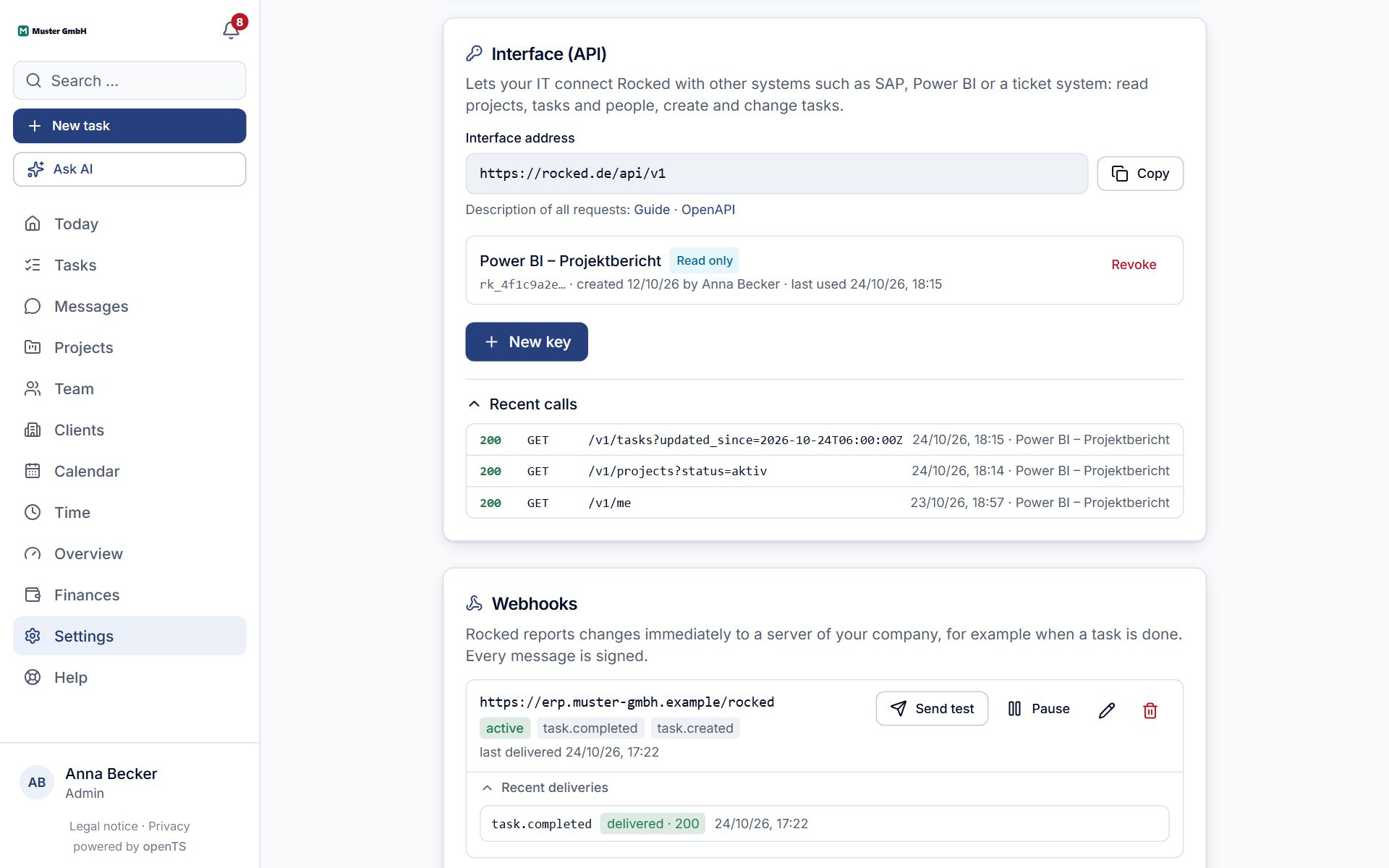
At rocked.de/api/v1: read projects, tasks and people, create and change tasks. One key per system, read only or read and write, every call logged for 90 days. Described as OpenAPI.
Webhooks
Rocked reports created, changed and completed tasks as well as project changes to your server, signed with HMAC-SHA256 and retried if it does not answer.
Permissions in the database
Who may see and change what is checked by the database itself. The API and webhooks follow the same rules: phase approvals still apply, confidential projects stay invisible.
Data sovereignty
Data centre in Frankfurt, an access log for every access by us, a company log for permissions and settings, export of all data and deletion by your admins.
On your own server
is also available as an annual licence for your own server, more under On your own server.
What cannot do, honestly
Better to say it here than in the third week of your roll-out.
- No automatic levelling. Rocked shows who is overbooked and what a scenario changes. A person decides what to move.
- Company account sign-in is not a switch in the software. We set up Microsoft and SAML once together with your IT. After that you set domains and the requirement yourselves.
- No automatic user provisioning via SCIM. Who may use Rocked is listed in your company’s phone list. You add new people there or bring them along when switching.
- Rocked on your own server is one step behind. Company account sign-in, API and webhooks are not available there yet.
- No certification of its own. Rocked itself is not certified to ISO 27001. The services underneath are audited according to their providers; details on the Security page.
- Not a replacement for accounting. Budgets, expenses and earned value yes. Invoices and bookings stay in your accounting system.
Frequently asked questions
Is a PMO tool?
Yes, since October 2026. Portfolio, capacity, scenarios, cross-project dependencies, risks, earned value, project requests and phase approvals are built in and live in the same software teams work in. What is missing is listed above on this page. The quickest way to see whether it fits your structure is a demo with your own projects.
How many projects and people can it handle?
We tested in a test company with 400 projects and 60 people. Prices apply up to 150 people; above that we make you an offer, also at a fixed price for the whole company.
Can we move over from Jira?
Yes. imports projects and tasks from Jira, as described on the “Switching” page. For your own systems there is the API.
How secure is the API?
Every key belongs to one company and may read only or also write. Only a checksum is stored, not the key itself. Confidential and password-protected projects are never visible through the API, and every call is logged for 90 days for your admins to see.
Do small teams need all this?
No. The PMO features are one switch. With it off, stays as simple as before.